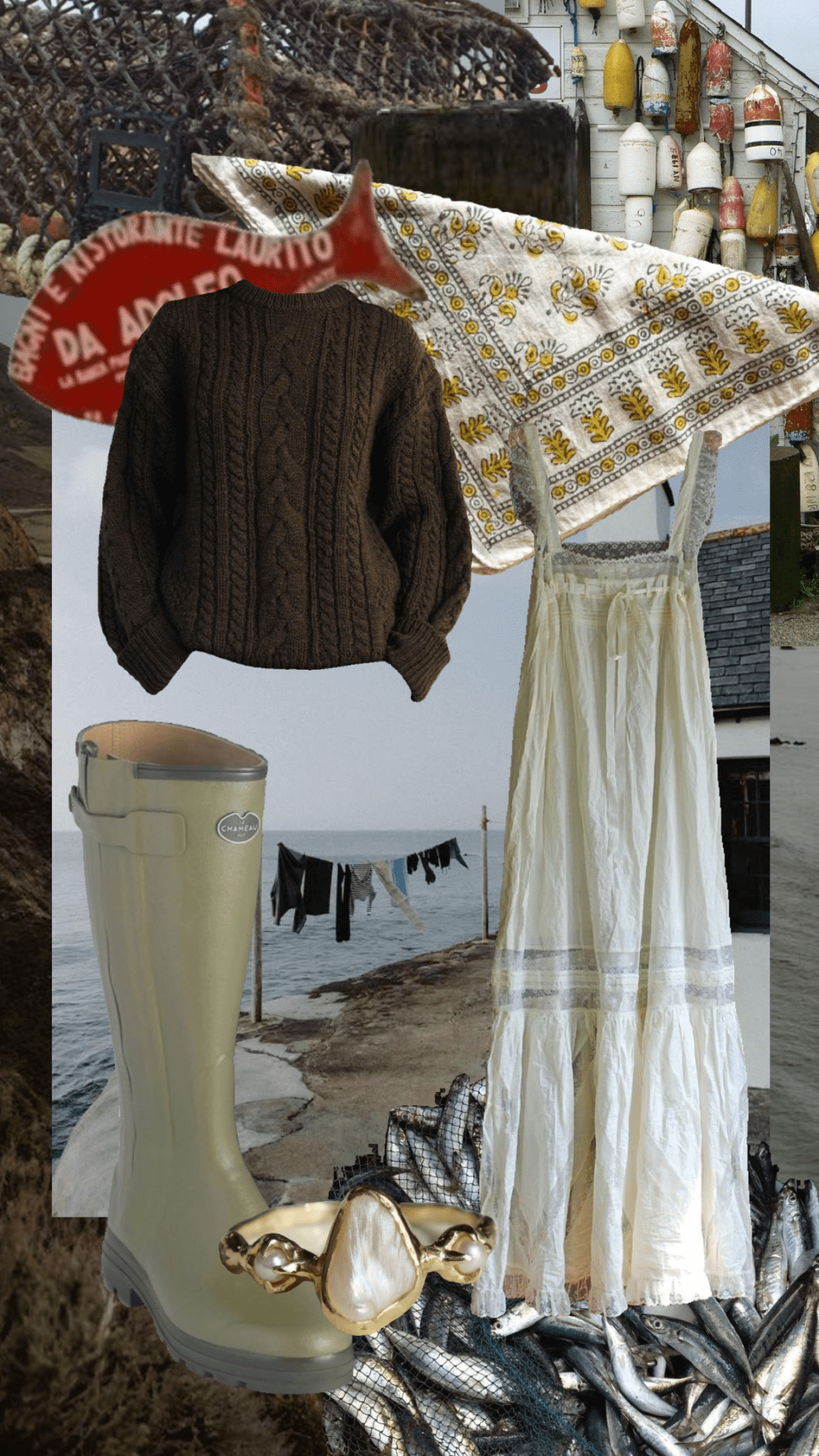
Picture this: It’s the day after Christmas. You and your family take a ferry to see your grandmother, who lives alone in a fishing town. You walk off the pier and notice a girl.
She’s dressed in baggy jeans, rolled just above her dark-green ankle‑high galoshes. She stands pensive in an oversized knitted sweater, a jean jacket layered over it, her braids tucked beneath a rust‑colored beanie. You were bored, but now you are in love.
Two years before I found out I was pregnant, Coastal Grandma was everywhere. She was linen pants and a knitted sweater over a blue‑and‑white button‑up. She was a crisp glass of wine, Otis Redding in the background, the sea breeze in your hair. Everyone—at least on my side of the internet—wanted to be divorced, living in their golden years, carefree and fabulous.
It wasn’t until this past year that that version of me began to feel out of touch and unattainable. As if the weight of the world had turned white linen pants into thick denim, stained by the salty spray of the ocean. Knitted sweaters seemed impractical unless you had something weatherproof hanging over them. And wine was out of the question.
Then I found a reasonable solution to my misguided, momentary sense of identity. It came in the form of the fisherman aesthetic. Durable and practical, it was as timeless as it was comfortably working‑class—a gentle nod to my desire not to be chic and well‑groomed, but lived‑in. As if I had lived a thousand lives with my pipe and an honest day of work. I wanted nothing to do with the casual classiness of the Coastal Grandma. Instead, I wanted everything to do with the rough, sea‑weathered fisherman.
That was until I found out about his daughter.
I was on Pinterest, looking for outfit inspiration and mood boards, when I came across her. Hardworking, resilient, and uncompromising in her femininity, she felt not only realistic but tender. This quality slipped through the fingers of the Coastal Grandma and was lost on the fisherman entirely.
The fisherman’s daughter is a member of the coastal working class. She is a response to hyper‑curated luxury, hustle culture, and the overly aestheticized soft‑life narrative. She carries domestic proximity to work without becoming the work itself. You see this in the way she balances the hard and tangible with innocence and whimsy: galoshes paired with cotton slip dresses layered under long knitted cardigans; jeans, a cable‑knit sweater, and a bandana.
She pulls inspiration from Virginia Woolf, Joan Didion, and Scandinavian domestic realism. A strong thread of New England maritime gives the aesthetic a place to live. It is thoughtful and moody, somewhere between daydreaming and brooding. The fisherman’s daughter lives in the house her grandfather left her father. She wears weathered neutrals and heirloom jewelry. On days she doesn’t have to work, her mornings are slow and quiet, her hair still in the bun she slept in well past noon.
This is what life feels like for me right now, which is why she is so relatable. All of this feels more attainable than a luxurious vineyard or ten years at sea. The clothes serve as timeless winter classics, and the mood lends itself to introspection. Days spent by the water, watching as time glides across the surface. Maybe you’ll go on a picnic on the cliff, or take a boat ride alone.
Maybe that’s all life is.
 light & gather
Leave a comment